Maladie d’Alzheimer de Françoise
Les Choses humainesFrançoise’s Alzheimer’s disease turns a fear of losing memory and selfhood into a progressive change in how she speaks, recognizes others, and lives. Its significance lies not only in the diagnosis but in the contrast between the woman whose work once gave her a public identity and the increasingly dependent person Jean continues to visit and care for. The disease is disclosed first as a frightening medical certainty, then made visible in the small, altered exchanges of daily life.
Diagnosis and the fear of losing herself
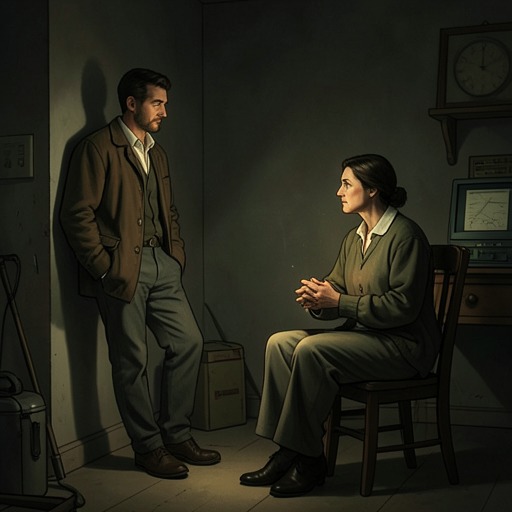
Françoise tells Jean that she is ill after he notices that she is holding back tears. She explains that she sought medical advice because of memory problems, and that examinations—including an MRI and a lumbar puncture—have confirmed the diagnosis. Her words convey more than a clinical finding: she believes she is finished. The prospect that frightens her is a future in which she loses her mind and memories and is reduced to physical and intellectual decline.
For Françoise, the diagnosis immediately raises the question of agency. She intends to arrange assisted suicide in Switzerland and asks Jean to help her; he tells her that she cannot ask that of him. The exchange makes clear that the disease is bound up with her attempt to decide what may happen to her as her capacity changes. The evidence does not resolve the disagreement at that moment, but it establishes a consequential divide: Françoise frames control over her death as a response to anticipated deterioration, while Jean is unable to accept the role she asks him to take.
Symptoms and the loss of recognition
The disease is initially described as too early to name with certainty, although Françoise already displays its characteristic signs: memory loss and confusion in her speech. Later, the change is evident in her everyday language. She calls Jean an obscenity when he arrives, and he has grown accustomed to the profanity that has entered her speech as the illness progresses. Her words remain forceful, but they no longer function as reliable signs of recognition or of the relationship they once shared.
Her ability to recognize Jean has also become uncertain. Over six months, her condition has deteriorated sharply; she recognizes him only about one time in three, and even he cannot be sure when she does. That uneven recognition makes each visit an encounter with both familiarity and estrangement. Jean continues to address her affectionately, while the illness has altered the language and memory through which their intimacy could ordinarily be acknowledged.
A life narrowed by illness
Françoise’s decline follows a history of professional and creative losses. After a suicide attempt and hospitalization, she was dismissed from the newspaper where she had worked. She later wrote freelance pieces for less prestigious magazines, then created a blog of her own. Although nobody read it, writing for the blog each day gave her a sense of existing. When the disease began to manifest more forcefully, she abandoned that activity as well.
The retreat from work becomes a retreat from public life. Since leaving her position, Françoise receives no visits or phone calls. Former colleagues send only impersonal group holiday emails or text messages with a smiley; the name that had once mattered in her workplace means little to them now. The novel places this social disappearance alongside her cognitive decline: she loses not just the ability to sustain her own writing but also the network that might have recognized her as a working journalist.
A particularly painful reminder arrives when the newspaper publishes an obituary column Françoise had written years earlier about an actress who fell into a coma after a household accident. Jean brings her a copy and tells her that there is an article by her in it. Françoise throws the paper to the floor. Jean reads the piece and feels that, in writing about the actress, Françoise had been speaking about herself. The newspaper has preserved her earlier words, but she no longer responds to their return as a recovered part of her professional identity.
Jean’s care and the material present
Jean remains with Françoise through the stages of her illness. He continues visiting and caring for her even though she no longer knows that he has rebuilt his life and no longer leaves home or reads. His visits are not an abstract pledge of loyalty: the novel gives them the shape of practical attention, including food chosen with her preferences in mind, help as she rises and sits, and care for her comfort at the table.
After leaving a court hearing, Jean walks to Françoise’s home and stops at a delicatessen for Parma ham, cherry tomatoes, apricots, and dark chocolate. When he arrives, she sits in a purple velvet armchair, her dog Claude at her feet, watching an animal documentary. Jean brings the food to the dining room and helps her to the table. As she eats a tomato, juice runs over her lips and down her chin, staining her pink blouse; he gently wipes her mouth with a napkin. He then helps her back to the chair and lies on the sofa a metre away, with Claude curled at her feet.
These domestic details do not reverse the disease or restore the recognition it has taken. They show what remains possible between them: Jean can remember what she likes, prepare a meal, steady her movement, and tend to her body even when shared history no longer reliably returns through her words. In a drawer in the living room, he keeps the assisted-suicide organization’s brochure and the documents Françoise signed when her illness had suddenly worsened. Their presence connects her earlier insistence on making decisions about her future with the ordinary care continuing around her in the present.
Narrative significance
Françoise’s illness is presented through different kinds of evidence: her own report of tests and feared decline, the clinical procedures that establish the diagnosis, and Jean’s observation of the changes that structure their visits. This movement from diagnosis to routine gives the disease a lived chronology. The MRI and lumbar puncture make it medically legible; the lost words, uncertain recognition, abandoned blog, and need for help at the table make its consequences legible in relationships and everyday actions.
The contrast between professional disappearance and private care is central to the portrayal. Françoise’s former colleagues reduce their contact to generic greetings, while Jean continues to arrive, bring food, and attend to her bodily needs. The disease thus exposes the difference between a public identity that can vanish when a person leaves work and a bond sustained through repeated acts of attention. At the same time, the narrative does not suggest that care restores Françoise’s former self: her recognition remains unreliable, her writing has stopped, and the documents concerning assisted suicide remain in the home. Alzheimer’s is both a medical condition and the force reorganizing what can still be shared between Françoise and Jean.